
全家福
Tech exchange drives China-Cambodia industrial cooperation at Phnom Penh machinery show_我的网站

A |
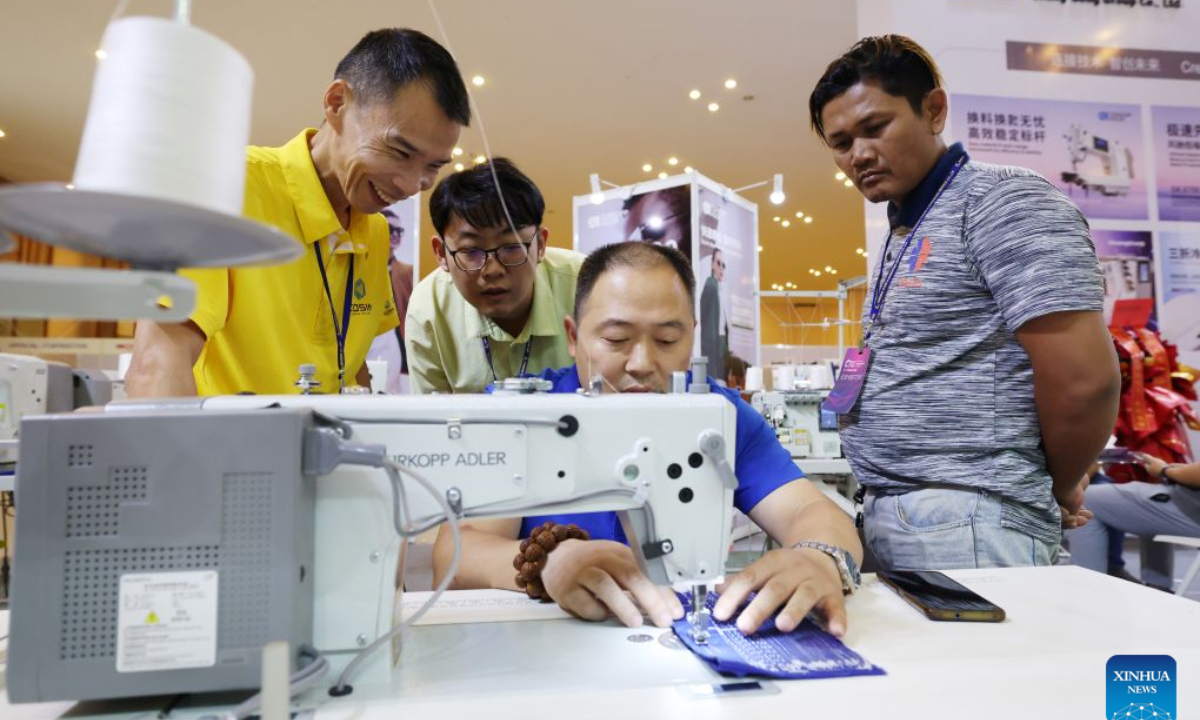
The four-day expo, which runs from Thursday to Sunday, features more than 200 local and international exhibitors.
A significant portion of these participants comprises Chinese companies across four core sectors: machinery and automation, textiles and garments, plastics and rubber, and printing and packaging.
Organized by Yorkers Trade & Marketing Service Co., Ltd. in collaboration with the Ministry of Industry, Science, Technology & Innovation, the expo provided a platform to showcase emerging industrial technologies, foster business connections and support the modernization of Cambodia's manufacturing sector.
According to official ministry data, Cambodia had 3,357 operational factories as of July 2026. These facilities employ over 1.35 million workers, more than 70 percent of whom are women.
Total factory investment in the kingdom reached approximately 28 billion U.S. dollars, a 29 percent increase compared to the same period in 2025. Additionally, industrial production during the first half of 2026 was valued at over 9.8 billion dollars, including roughly 7.3 billion dollars in goods manufactured for export.
Cambodian Minister of Industry, Science, Technology and Innovation Hem Vanndy urged Cambodian enterprises to embrace advanced technologies to boost productivity, improve quality, and sharpen their competitive edge.
"Artificial intelligence, production-line automation, robotics, digital technologies and smart manufacturing are increasingly determining the competitiveness of nations," he said during the expo's opening ceremony on Thursday.
"Cambodia cannot remain outside this transformation," Vanndy said. "We must embrace new technologies to increase productivity, reduce costs, improve product quality and strengthen the competitiveness of our enterprises."
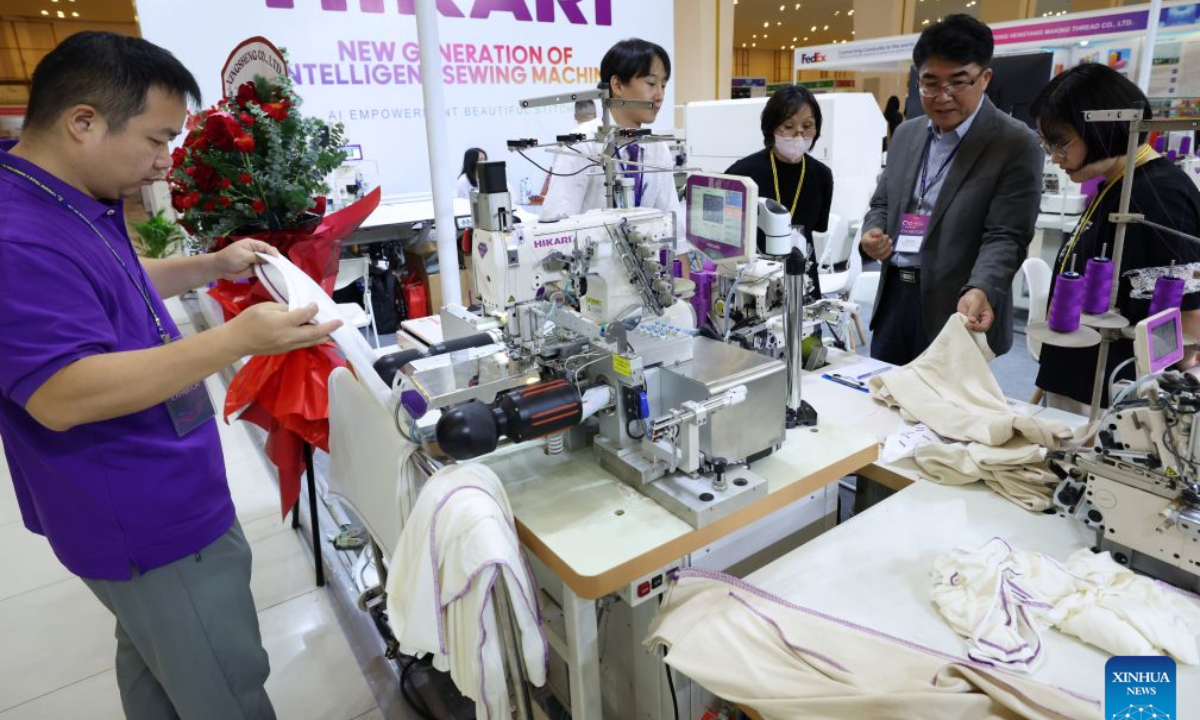
Chim Vinly, the expo's organizing staff member, said the exhibition plays a vital role in introducing innovative manufacturing technologies to Cambodia's garment sector, as attendees can explore a diverse range of advanced machinery designed to elevate production standards.
"Most exhibitors represent the textile and garment industries, with the majority being local and Chinese companies," he told Xinhua on Saturday.
"These advanced manufacturing tools have boosted productivity and modernized local production chains. In particular, they make work faster and more efficient," he added.
Vinly said the annual event plays a vital role in further expanding bilateral trade between China and Cambodia.
"Chinese investment is crucial to boosting Cambodia's economic growth and generating job opportunities for the local workforce," he said.
Bo Seyma, a mechanic at Kosin Sewing Machine Co., Ltd., which supplies Cambodian factories with equipment from the Shanghai-based Shang Gong Group, said the expo is vital for showcasing cutting-edge machinery to the local garment industry.
He said the Kosin company is promoting sewing, embroidery, button, and backstitching machines, along with other equipment, to factories in Cambodia.
"These industrial machines are in high demand, with numerous factories placing purchase orders with our company," he told Xinhua on Saturday.
Seyma said these advanced machines are high-quality and built to last.
"These machines accelerate production efficiency while effortlessly meeting customer demands," he said.
Thong Mengdavid, deputy director at the China-ASEAN Studies Center of the Cambodia University of Technology and Science, said that Cambodia, a country heavily dependent on textiles and garments, has seen its cooperation with China evolve from providing raw materials like fabrics and finished consumer goods toward technological cross-pollination.
This allows local Cambodian plant managers and entrepreneurs to evaluate high-grade machinery directly, he added.
"Integrating China's technology, machinery, and tools into Cambodian factories will address several challenges in the local economy, such as enhancing output per hour, reducing material waste caused by human error, and fostering skill development among the workforce," Mengdavid said.
。
前几天,有一个跑友去国民体质监测中心进行体质监测,给出的结果是——刚过及格线!他很纳闷:他每周跑步5次,每次10公里,风雨无阻,不应该是优秀吗?怎么会刚刚及格呢?答案很扎心,太偏科了!跑步特长跑步确实是极佳的有氧运动,它能高效提升心肺耐力,燃烧脂肪,提升腿部力量。这毋庸置疑,每一个坚持奔跑的人,这几个方面都很强!但这些强项,只是体质监测“全科考试”里的其中几项,并没有包含全部!国民体质监测中心测的不是“单项”,而是身体的各个方面。所以,这个跑友测的结果,心肺耐力、腿部力量、体脂率都是满分!但,他的握力、背力,还有身体的爆发力都不是太强。
。
B | 还有最差的是身体的平衡力和柔韧性,都处于不及格的水平。
因此,最后得出的综合分值是刚刚及格。
C |
偏科很多其实,不单单是跑友,“偏科”的人很多很多!经常做单一运动的人,综合体质评分往往低于运动种类丰富的人。跑步爱好者很多都属于:纯有氧偏科型。心肺功能很强大,跑个十公里不带喘气的。但一测握力,手无缚鸡之力;一做“坐位体前屈”,手指离脚尖还有一巴掌远。另外一种是:力量偏科型。这些人大部分都是健身房里的大块头,卧推深蹲一把好手,全身的力量很强。但让他跑个800米,脸憋得通红,心率飙上天。这类人肌肉发达,但心肺耐力是短板,日常容易感觉“气不够用”。
D |
还有一种偏科是:拉伸偏科型。这些大部分都是瑜伽达人,柔韧性让人羡慕。但缺乏力量和心肺训练,稍微干点体力活就累得不行,属于“软而不强”。破解之道作为一个跑步爱好者,偏科不怕,在运动中,稍微加两项内容即可。一方面,增加力量训练。每周加1次核心力量训练,比如:平板支撑、卷腹,同时也可以穿插一些上肢力量训练,比如推举,硬拉等。跑友穿插力量训练,不单弥补了体质的短板,其实也是有助于跑步运动的。
E |
另一方面,增加拉伸训练。其实也没有必要专门去练瑜伽,每次跑步结束后,专门抽出10—20分钟时间做一下身体的全面拉伸即可。不仅可以提升身体的柔韧性,还能避免跑步受伤,何乐而不为?其实,很多跑友做得都很好,不仅坚持跑步,还刻意去追求身体的全面发展。比如,有些跑友还会穿插一些其他运动,比如骑车、游泳、球类、瑜伽等等,都是非常好的运动习惯。我们身边的跑友,在体质监测中得满分的,比比皆是。写在最后坚持常年跑步,是一件了不起的事。
F | 这说明你已经战胜了懒惰,拥有了自律和毅力。这一点,确实值得骄傲。

G | 但,单一运动只能解决单一问题,健康需要全面投资。因此,在坚持跑步的同时,要记得加上“力量训练”和“拉伸训练”哟!真正的好身体,是全能,而不是偏科。更不用说,在养成跑步爱好的基础上,再加上“力量训练”和“拉伸训练”,并不是难事。

H |
Current article:http://4zk1.fanfutaopoulaxiong.pics/18g1fko/20260826/64286.html
Published on:21:35:24